Showing posts with label History. Show all posts

Thursday, February 14, 2013

1863 to 1963 to 2013

When he established Negro History Week in 1926, Dr Carter Woodson realised the importance of providing a theme that would focus the attention of the public . The Association for the Study of African American Life and History designated the theme for the 2013 Black History Month as the celebration of the 150th and 50th anniversary of two African American turning points: the 1863 Emancipation Proclamation and the 1963 March on Washington.

The Emancipation Proclamation, issued by President Abraham Lincoln on January 1, 1863, declared that slaves in all confederate states then at war with the Union were "forever free" and made them eligible for paid military service in the Union Army. Although it did not end slavery in the nation, it did transform the character of the war. After the Proclamation was made, every advance of Federal troops expanded the domain of freedom, and black men were allowed to serve in the Union armed services. By the end of the war almost 200,000 black soldiers and sailors had fought for freedom.

The March on Washington for Jobs and Freedom took place on August 28, 1963 in Washington, DC. More than 200,000 demonstrators took part in the walk. Dr Martin Luther King, Jr delivered his I Have a Dream speech from the steps of the Lincoln Memorial, noting that the Emancipation Proclamation gave hope to black slaves. The following year Congress passed the Civil Rights Act of 1964 as a concrete step of fulfilling the promise of the Emancipation Proclamation.

A good way to celebrate Black History Month is to learn more about these two major events in our history - and especially to educate our young people about their significance. What better place to learn than your Library. Come in to see all that we have to offer and bring children with you.

Friday, January 18, 2013

Favorite Reads 2012: The Greater Journey

I love to read nonfiction, especially history and biography. Obviously, David McCullough is one of my favorite authors. His books are so well written that you might think they were fiction. They definitely are not, as they are meticulously researched.

His latest, The Greater Journey: Americans in Paris, is a bit different from his earlier books. It's not about one person or event, and it doesn't take place in the United States. It's about the hundreds of Americans who went to Paris between 1830 and 1900 - not to visit or live - but to study. These were American artists, doctors, writers, scientists, and others who were adventurous enough to cross the Atlantic Ocean (which in those days was a dangerous and long trip) just to learn. They went on to have a tremendous effect on American culture and history.

What we as Americans may not realize is that during these years there was no place in America to learn these skills. Since they had to leave home, they decided to go to the best place to learn - Paris, France. Paris was the intellectual and cultural center of the world at that time. The book ends in 1900, because by then, it was no longer necessary to leave the US to study, mainly because of these intrepid adventurers who brought their knowledge home.

I was amazed at how many well known American artists, physicians, writers, and others made the "greater journey" to Paris. Elizabeth Blackwell, Oliver Wendell Holmes, Mark Twain, Samuel Morse, James Fenimore Cooper, Harriet Beecher Stowe, Charles Sumner, John Singer Sargent, and Mary Cassatt are just a few.

Through the eyes of this author you will come to love Paris and vividly see the impact of this city upon these American students. You will also come to realize the tremendous effect these travelers had on our country. It also has many magnificent color pictures. This is an inspiring, enlightening, and entertaining book that I can highly recommend.

Friday, March 9, 2012

The History of Women's History

Adeline Whitney
The public celebration of women's history in this country began in 1978 as Women's History Week in Sonoma County, California. The week including March 8, International Women's Day, was selected. In 1981, Senator Orrin Hatch (R-Utah) and Representative Barbara Mikulski (D-Md.) cosponsored a Joint Congressional Resolution proclaiming a national Women's History Week. In 1987, Congress expanded the celebration to a month, and March was declared Women's History Month.
 
Sybil Ludington
Before 1970, women's history was rarely the subject of serious study. Historian Mary Beth Norton recalls, "only one or two scholars would have identified themselves as women's historians, and no formal doctoral training in the subject was available anywhere in the country." Since then, the field has gone through great change. Today almost every college offers women's history courses and most graduate programs offer doctorial degrees in the field.
Phillis Wheatley
Two significant factors contributed to the emergence of women's history. The women's movement of the sixties caused women to question their invisibility in traditional American textbooks. The movement also raised the aspirations as well as the opportunities of women, and produced a growing number of women historians.
Now that you have read a little about the history of women's history here are just a few of the many women that made a difference in the world:
Maya Lin
In 1882 , Adeline Whitney invented the wooden Alphabet Blocks to help children learn to read.
Sybil Ludington was 16 years old when she joined the American Revolutionary War forces, riding 40 miles on horseback in the dark of night to obtain military reinforcements.
Phillis Wheatley was sold as a slave to a Boston family when she was six years old. She was taught to read and by the time she was 13 she had written her first poem. She was the first black woman to publish poetry in the United States. Her book, Poems on Various Subjects, Religious and Moral, was published in 1773.

Chief Wilma Mankiller
Maya Lin is an architect who was born in 1960. When she was only 21, she won a national competition to design and build the now famous Vietnam Veterans Memorial in Washington D.C.
Chief Wilma Mankiller, born in 1945, was a longtime activist for Native American rights. She served as Chief of the Cherokee Nation from 1985 - 1995, the first woman in modern history to lead a major Native American Tribe.

Nancy Kassebaum
Nancy Kassebaum, born in 1932, was elected to the Senate from Kansas in 1978. She was the only woman there. She served for 18 years.
There are so many accomplished women both past and preent who have enriched the lives of people all over the world. If you would like to know more about these and other notable women stop in the library and browse our biography collection.

Friday, February 17, 2012

Mardi Gras in Natchez and Around the World

Mardi Gras (Fat Tuesday) or Carnival generally refers to the time between Ephiphany and Ash Wednesday, when popular practices include wearing masks and costumes, overturning social conventions, dancing, sports competitions, parades, and other celebrations before the penitential season of Lent. It is an important time in most Catholic countries and communities.


The Brazilian Carnaval is their most famous holiday and accounts for 80% of their annual beer consumption and 70% of their annual visitors. The celebration in Rio de Janeiro is the largest carnival in the world.


The Carnival of Venice is one of the oldest in Italy (12th century), and the subversive nature of the festival is reflected in the many laws created over the centuries in Italy attempting to restrict celebrations. Carnival of Viareggio is the most famous one in Italy.


Mardi Gras arrived in the United States along with the French. The settlement of Mobile AL became the first capital of the territory of Louisiane in 1702. The next year was the first celebration of Mardi Gras in the US. In 1720, Biloxi became the capital, and the Mardi Gras followed, as it did when New Orleans became the capital in 1723. Mardi Gras is celebrated all along the Gulf Coast, although most Americans associate it with New Orleans.


Elodie Pritchartt's aunt in
1909 Mardi Gras Parade
The first celebration of Mardi Gras in Natchez may have been in 1875, according to Natchez: An Illustrated History by David Sansing, Sim Callon, and Carolyn Vance Smith.

"In 1875 Natchez became the first town in Mississippi to hold a Mardi Gras celebration. Rex and his retainers arrived at the Natchez landing on a steamboat appropriately named “Royal Steamer.” In the evening following a downtown parade, the Italian Society of Natchez held a gala Mardi Gras ball."


The diary of Rev Joseph Buck Stratton has this description from 1898.
"Today was a public holiday devoted to the celebration of the rites of what is known in this region, once dominated by the French and Spaniards, as Mardi Gras. General decoration of buildings took place, processions of the Fire companies, military, trades, maskers, etc. occupied the day and the population of the town and country filled the streets. At night a beautiful torch-light procession in which the king of the Carnival presided, traversed the streets. It was composed of a number of floats on which a succession of tableaux – historical and other was displayed greatly to the delight of the spectators. The pageant was elaborate and tasteful and exceeded everything of the kind which had ever been witnessed in Natchez. A grand ball at the Institute Hall closed the exercises. It is supposed such saturnatia pay financially. It is more than doubtful of the pay morally; “in like manner did not our Fathers”.
Mimi Miller, Executive Director of Historic Natchez Foundation, is quoted in an article in County Living, where I also found the quotes above and the photo.
"A major fire broke out during the festivities in 1909 and the fire trucks had been appropriated as floats. Needless to say, the fire caused a lot more damage than it might have otherwise. The fire and the boll weevil, which first appeared in Mississippi in a Natchez area cotton field in 1907, caused the demise of Mardi Gras. When it was reborn in the early 1980s, the first krewe named itself appropriately--the Krewe of Phoenix.".
And that krewe rolls out once again in Natchez today at 5 pm through downtown. Don't miss it!

Friday, February 3, 2012

Why Do We Have Black History Month?

Well, I guess that it was all truth when someone spoke the words: "You learn something new everyday!" While beating myself over the head about a blog idea, a light went off over the top of my head and like a ton of bricks, it hit me: Black History Month!
Then, two more tons of bricks landed on my head with a loud "THUD!" I realized that I did not know much about black history month! Who would have thought it, right? Who knew that Black History Month had a theme? Who knew that it first started out as ONE week? Well, I certainly didn't before I went on a "fact hunt" and gathered some information for your enjoyment (and mine, seeing as that before this blog idea happened, I knew only about 25% of this information)!
Enjoy:
Black History Month is a month set aside to learn, honor, and celebrate the achievements of black men and women throughout history. Since its inception, Black History Month has always been celebrated in February. Find out how Black History Month originated, why February was chosen, and what the annual theme for Black History Month is for this year.
The origins of Black History Month can be traced back to a man named Carter G. Woodson (1875-1950). Woodson, the son of former slaves, was an amazing man in his own right. Since his family was too poor to send him to school as a child, he taught himself the basics of a school education. At age 20, Woodson was finally able to attend high school, which he completed in just two years.
He then went on to earn a bachelor's and master's degree from the University of Chicago. Three years after earning his doctorate, Woodson made a trip that had a great impact on him. In 1915, he traveled to Chicago to participate in a three-week celebration of the 50th anniversary of the end of slavery. The excitement and enthusiasm generated by the events inspired Woodson to continue the study of black history year-round. Before leaving Chicago, Woodson and four others created the Association for the Study of Negro Life and History (ASNLH) on September 9, 1915. The following year, the ASNLH began publication of the Journal of Negro History.
Woodson realized that most textbooks at the time ignored the history and achievements of blacks. Thus, in addition to the journal, he wanted to find a way to encourage interest and study of black history. In 1926, Woodson promoted the idea of a "Negro History Week," which was to be held during the second week of February. Woodson chose the second week of February to celebrate Negro History Week because that week included the birthdays of President Abraham Lincoln (February 12) and Frederick Douglass (February 14). The idea caught on quickly and Negro History Week was soon celebrated around the United States. With a high demand for study materials, the ASNLH began to produce pictures, posters, and lesson plans to help teachers bring Negro History Week into schools. In 1937, the ASNLH also began producing the Negro History Bulletin, which focused on an annual theme for Negro History Week.
In 1976, the 50th anniversary of the beginning of Negro History Week and the bicentennial of the United States' independence, Black History Week was expanded to Black History Month. Ever since then, Black History Month has been celebrated in February around the country.
Since its inception in 1926, Negro History Week and Black History Month have been given annual themes. The first annual theme was simply, "The Negro in History," but since then the themes have grown more specific. This year's theme is: Black Women in American Culture and History.
We have a display on this theme in the Children's Section (see picture). Come to your Library - and bring your children - to see the display and check out books on these historical women.  

Friday, January 6, 2012

LSU's First Touchdown & First Win were in Natchez!!

1893 was the first year LSU had a football team, and they were coached by a professor. They played one game, which was against Tulane. LSU lost and never even scored. However, this was the beginning of the Purple & Gold. They wanted to use Mardi Gras colors on their uniforms, but they couldn't find any green ribbons because the Tulane Green Wave bought them all.

1894 LSU football team
In 1894, they got a real football coach (Albert Simmons) and played three games. Their first game was on November 30 and was against the Natchez Athletic Club in Natchez. Here they scored their first touchdown and went on to get their first win with a score of 36 - 0. The team's captain, Samuel Marmaduke Dinwidie Clark, became the first LSU player to ever score a touchdown.

Johnny Waycaster had heard this story and asked us if we had the Natchez paper for that time on microfilm. We looked, and sure enough there was an article in the Natchez paper, The Saturday Evening Banner. (You just never know the treasures and trivia your Library has available!) Here's the story - it's hilarious:

The foot-ball game between the University team of Baton Rouge and the Natchez team came off yesterday afternoon. The game was to have taken place on Thanksgiving day, but the visitors were detained on a sand-bar near Lehmann's Landing, on board the steamer Royal, until yesterday morning, when they came up on the Natchez. The game attracted a large crowd to the park, as a foot-ball match was something new for Natchez. It proved to be quite entertaining to those present, but the home team proved to be too weak for the visitors, the score standing 36 - 0. The visitors were entertained last evening at the hospitable home of Capt. F. J. Arrighi, whose son, Hughes Arrighi, is a member of the Baton Rouge team. They departed for home this morning well pleased with their visit, and the courteous treatment received while here. The Natchez foot-ball colors, red, orange, and blue, have been quite prominently displayed during the past few days.

So Natchez families have been sending their children to LSU for a long time - and Natchez hospitality and partying after games are obviously well established traditions.

LSU's second game that year and first home game was against Ole Miss, and LSU had their first loss to Ole Miss. LSU's only touchdown was scored by the coach, who was presumably a player-coach.

1895 LSU football team
In 1895, Coach Albert Simmons, in his last year at LSU, helped the Tigers to their first undefeated season  in LSU football history. The season also featured the first home victory in LSU history with a win over Tulane in front of 1,500 spectators. They did not play Ole Miss that year - but they did play Alabama in the last game of the season. Surely that will happen again on Monday!.


1896 LSU football team
In 1896, LSU played 6 games, was again undefeated, and won their first Conference Championship. This time, they beat Ole Miss for the first time. And this rivalry continued forever.


NOTE: The pictures and some of this information came from Wikipedia.

Thursday, December 15, 2011

Answers to Questions about Christmas Symbols

Not long after Thanksgiving the phone at my reference desk began to ring and my email box began to fill with questions about the symbols of Christmas. What's a busy librarian to do? Go check out a reference book about Holidays and Traditions, and thats just what I did and here is what I found. By the way these are actual questions.
Q: Is Santa Claus the same person as St. Nicholas?
A: Yes and no. The original Santa Claus was Nicholas, the legendary saint who was bishop of Myra (Turkey) in the fourth century. He was usually shown wearing the fur-trimmed robes of a cleric, with a beehive (symbolizing industry) and a bulldog (fidelity) at his side. He was a gift giver but also a disciplinarian, bringing switches and rods for children who misbehaved. December 6 was his feast day, and in many countries, it is on this day, not Christmas Eve that St. Nicholas arrives to hand out his presents and punishments. It wasn't until the December of 1823 when Clement Moore's wrote the poem "A Visit from St. Nicholas" that the American Santa Claus was transformed from a tall, slim bishop to a jolly, overweight fellow who wore a red suit and entered the house via the chimney.
Q: Are reindeer for real and can they really fly?
A: Again, yes and no. More than 600 years after the death of St. Nicholas, Russians carried his legend back from Constantinople, and he became Russia's patron saint. From there his story spread to Lapland, home of the reindeer, which may explain why the modern Santa lives at the North Pole and gets around in a sleigh pulled by eight reindeer. It was again Clement Moore's poem "A Visit from St. Nicholas" that popularized the names of Santa's reindeer: Now Dasher, Dancer, Prancer and Vixen. On Comet, Cupid, Doner and Blitzen! Rudolph is a whole other question!
Q: Are Luminarias more than just a pretty way to light your path?
A: Yes, Luminarias mean "lights" or "illuminations" in Spanish. The word also refers to the small bonfires that illuminate the dark nights of the Christmas season throughout the American Southwest. These bonfires are made from pinon pine logs that have been stacked in log cabin style to form a box about three feet in height. Some believe that luminarias can be traced back to the fires that warmed the shepards to whom the birth of Jesus was announced. Today luminarias acn be seen on Christmas Eve in front of churches, homes, and public plazas.
Q: What is the history of the Christmas carol "We Wish You a Merry Christmas"?
A: This popular secular 16th century English carol is from West Country of England. It is one of the few traditional holiday carols that make mention of the New Year's celebration. This song actually reflects the Christmas tradition of showering gifts on the people who wandered from house to house (known today as carolers), singing these Christmas songs to please the wealthy people of the community.
Q: Why do we send Christmas cards?
A: In Ancient Rome, it was the custom to exchange greetings and gifts on the first day of January. With the advent of Christianity , the giving and receiving of such tokens continued in some European countries, often taking the form of New Year cards. These contained no reference to Christmas and were sent out after December 25 so they would arive on New Year's Day. The first printed Christmas card was produced in England in 1843. Designed by John Calcott Horsley, it sold for a shilling and looked like a postcard. It wasn't until the 1880s that cards became folders of four, eight, or more pages. Cards became more elaborate throughout the Victorian period, with "frosted" surfaces, fancy cut edges, layers of lace-paper, and other forms of decoration. Now, in the twenty-first century the christmas card is still out there, I saw them in Walgreens. There were religious ones and some with cute little penguins and little forest friends dancing around the decorated christmas tree. There were even some for those who enjoy a little "wicked" fun. I love Christmas cards. To me, it's more special whem someone sends me a hand written card with a scene that warms my spirit. After looking at ten different designs and still not making up my mind as to what I wanted I decided to rebel against my own tradition and send everyone a Christmas E-Card... So now you know a little bit about some of our more famous Christmas traditions
HoHoHo...Happy Holidays to All!

Friday, December 2, 2011

Tour of Homes Preview: Stratton Chapel (Refreshment Center)

The Friends of the Library annual Christmas Tour of Homes is Sunday, December 4, 2 - 5 pm. Admission is $15 for one ticket or $25 for two tickets. Tickets may be purchased at the Armstrong Library, Natchez Pilgrimage Tours, or at any of the homes the day of the event. You can tour four beautiful homes in any order and have refreshments at Stratton Chapel. This is the final preview of the Tour of Homes. Two homes were previewed last week, and the two more were previewed earlier this week.

Stratton Chapel
(Refreshment Center)
405 State Street
Located in the First Presbyterian Church

Located behind the Federal style First Presbyterian Church downtown and across from City Hall is an outstanding collection of photographs taken from as early as 1840 and offering a grand depiction of life in Natchez over the course of its early history. The collection boasts over 500 photographs of steamboat activities along the river, the families and homes of Natchez, and downtown Natchez as it once looked in the days of old. The collection for viewing is made possible through the generosity of the late Dr Thomas Gandy and his wife Joan who spent many years restoring the photographic works of Henry and Earl Norman.

Refreshments will be served to the accompaniment of organ music.

Wednesday, November 30, 2011

Tour of Homes Preview: Staniforth House

The Friends of the Library annual Christmas Tour of Homes is Sunday, December 4, 2 - 5 pm. Admission is $15 for one ticket or $25 for two tickets. Tickets may be purchased at the Armstrong Library, Natchez Pilgrimage Tours, or at any of the homes the day of the event. You can tour four beautiful homes in any order and have refreshments at Stratton Chapel. This is final preview of one of the homes. The first two homes were previewed last week, and the third was previewed earlier this week. Later this week, we'll preview Stratton Chapel, where the Refreshment Center will be.

Staniforth House
315 North Rankin Street
Home of Kirk Bondurant & Bruce Zabov

Built in 1852, the Staniforth House is a classic Greek revival brick cottage. Thomas Staniforth, its builder, was a Natchez contractor/builder who lavished extra attention on what was a comparatively modest house for the time and neighborhood, probably because it served to advertise his business. Original casings highlight the large windows across the front, and fireplaces grace several rooms.

Large antique salvaged windows have been added to the kitchen, providing a lovely view across the back gallery and walled garden toward Holy Family Church. Other particularly attractive touches are the decorative painted paneling restored in the dining room and the faux stone walls in the entrance hall. Beautiful cypress cabinets complete the kitchen. The modern and handsomely upgraded baths make this home truly comfortable.

Many Natchezians will remember a previous owner repainting the bricks. An article in the Natchez Democrat in 2001 indicated that he had found photographs in Dr. Thomas Gandy’s collection including one taken by Marshall Gurney in April 1865, showing the front and northwest sides of the house. The walls were brick with a white cornice along the side.

The people staffing the house on the day of the tour include some of the people who did the actual restoration work on the house.

The Staniforth house is the home of Kirk Bondurant and Bruce Zabov. They have restored it carefully. Furnishings include antiques as well as interesting artifacts and memorabilia from years of living in Key West and Costa Rica.

Monday, November 28, 2011

Tour of Homes Preview: Maples House

The Friends of the Library annual Christmas Tour of Homes is Sunday, December 4, 2 - 5 pm. Admission is $15 for one ticket or $25 for two tickets. Tickets may be purchased at the Armstrong Library, Natchez Pilgrimage Tours, or at any of the homes the day of the event. You can tour four beautiful homes in any order and have refreshments at Stratton Chapel. This is the third preview of one of the homes. The first two homes were previewed last week, and the fourth will be previewed later this week.

Maples House
506 Orleans Street
Home of Lisa & Ken Maples

This property has links to several families with long histories in Natchez, including the Pattersons, Reeds, and Brandons. In 1882, James William Henry Patterson and his wife Sarah Love Reed bought the property on Orleans Street from Rachael O’Conley. He borrowed money on the property in July 1885 to build the house. James was owner of Chamberlain & Patterson Dry Goods Company on Main Street with his partner James Chamberlain.

Ken and Lisa Maples acquired the house in 2008. They have updated the swimming pool and added a spa and landscaping to the backyard. They recently restored the front porch to its original period style and are in the process of adding an outdoor kitchen and living space to the rear of the house.

Friday, November 25, 2011

Tour of Homes Preview: Doyle House

The Friends of the Library annual Christmas Tour of Homes is Sunday, December 4, 2 - 5 pm. Admission is $15 for one ticket or $25 for two tickets. Tickets may be purchased at the Armstrong Library, Natchez Pilgrimage Tours, or at any of the homes the day of the event. You can tour four beautiful homes in any order and have refreshments at Stratton Chapel. This is the second preview of one of the homes. The first home was previewed earlier this week, and the last two will be previewed next week.

Doyle House
704 State Street
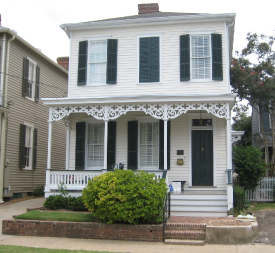
Home of Chesney & Marc Doyle

One of three, almost identical, two story houses built by J Foggo Dixon in 1880, 704 retains its original front porch and Victorian gingerbread. In 2007, Marc and Chesney Blankenstein Doyle undertook a complete renovation. In Spring 2011, they finally moved in with their twins.

Keeping the original footprint of the house, the Doyles created a three bedroom/three bath home with all modern amenities. Seven roofs were removed to install new architectural shingle. Central air and heat were added for the first time.

The family has been in the home since 1939. Her mother (Kathie Boatner) lived there until she married Rawdon Blankenstein in 1957. Their four children knew 704 as “Gram and Biggie’s house.” Their grandmother and great aunt had always run a tight ship, evidenced by the typewritten “Privileges and Rules of this Playroom” from 1942 that Gram created for Kathie and her playmates, including “P.S. When grown-ups want to use the front gallery please vacate!”

Wednesday was Gram and Biggie Day. Sliding down the banisters was allowed with adult assistance. Wooden blocks tied to socked feet with string were ice skates for sliding across the wool rugs. Gram even convinced the children that wire brushing the mildew off patio bricks was fun!

The dining table, a favorite gathering spot, was on the steamboat Springer when it sank near Rodney. The table was rescued and sold to Chesney’s greatgrandfather, Alfred Vidal Davis of Tacony Plantation in Vidalia.

Tour hostesses include Kathie Boatner Blankenstein’s childhood friends, all of whom were subject to the 1942 Rules.

Wednesday, November 23, 2011

Tour of Homes Preview: Callon House

The Friends of the Library annual Christmas Tour of Homes is Sunday, December 4, 2 - 5 pm. Admission is $15 for one ticket or $25 for two tickets. Tickets may be purchased at the Armstrong Library, Natchez Pilgrimage Tours, or at any of the homes the day of the event. You can tour four beautiful homes in any order and have refreshments at Stratton Chapel. This is a preview of one of the homes. Others homes will be previewed in later posts.

Callon House
400 South Pearl Street
Home of Katherine & Lindsey Callon

This Greek Revival cottage was built for Thomas and Elizabeth Mackin. The construction and cost are documented in an 1852 lawsuit. A deposition filed by the Mackins states they built a "Dwelling House" valued at $3,000 and "Fencing & Out Houses" valued at $1,000, after buying the property at a sheriff's sale in 1841. Andrew Brown Sawmill Papers record sales of building materials, including a large amount of interior plastering lath, indicating that the house was completed in 1843.

The 1850 census shows both Thomas and Elizabeth were born in Ireland. The quality of Mackin's house indicates that he was probably a levee contractor who boarded his levee workers on the property. Levee building was a common profession for Irish immigrants in river towns.

In 1858, the Mackin’s sold their residence to Ansel H Kendrick for $3,200 who sold to Cade L Holden in 1877, and it remained in the family until 1901. It was last the property of Eulalie Holden Reed and husband Richard F Reed, who published the pamphlet, The Natchez country; from the settlement by the French to the admission of Mississippi as a state.

The house sold frequently until Lindsey and Katherine Callon bought the house in 2009 and created the attractive historic cottage. Its restrained Grecian simplicity features a simple portico sheltering the doorway set within sidelights and transom. Well detailed dormers light the upper half story. An original two room dependency was later relocated to the rear of Pleasant Hill.

Thursday, May 5, 2011

The Prince Is Coming to Natchez

Earlier I posted an article about the Prince from Natchez, and the film about him. Now the film is coming to Natchez.

Film & Conversation

Prince Among Slaves is an award winning PBS documentary about the fascinating life of Abdul Rahman, a West African prince enslaved in Natchez, Mississippi for 40 years, who through improbable circumstances won his freedom and became one of the most famous men of his day.

Sunday, June 5, 2:30 — 5:30 pm
City Auditorium
FREE and open to the public

Special guest Terry Alford, author of the book upon which the film is based, will introduce the film, describing how he came to write this story and how it became a film.


Following the film, the audience will break into small groups to talk about the film. Leading the conversation will be special guest Amad Shakur, founder of the Center for the African Diaspora, a research institute in Charlotte, North Carolina.


All attendees will receive a free DVD of the film and are invited to attend a reception with refreshments following the event to honor the guest speakers at the NAPAC Museum.

Event Partners:
  • Alcorn State University
  • Antioch Missionary Baptist Association
  • Bluff City Post
  • City of Natchez
  • Copiah Lincoln Community College
  • Friends of the Armstrong Library
  • Historic Natchez Foundation
  • Judge George Armstrong Library
  • NAACP
  • Natchez Association for the Preservation of Afro American Culture
  • Natchez Convention & Visitors Bureau
  • Natchez Historical Society
  • National Endowment for the Humanities
  • National Park Service
  • Unity Productions Foundation

Thursday, March 17, 2011

The Prince from Natchez

Did you know that Natchez once had a Prince? Right around the beginning of our country, a remarkable man came to Natchez.

Abdul Rahman was trilingual, a successful military general, and the heir to Futa Jalon, the West African Empire, which was the size of Great Britain. However, during a war with another African country, he was captured and sold into slavery.

He was bought by Thomas Foster of Natchez and brought to his small, struggling plantation. Abdul Rahman told everyone that he was a Prince and his father would be happy to pay a ransom for his return. Of course, no one paid any attention, but they did start calling him Prince. He was a valuable slave and helped Foster develop the planation into a successful, profitable venture. He also married and had 9 children.

Through improbable circumstances, twenty years into his enslavement he was reunited with a marooned sailor that his father had rescued decades earlier. This event brought the first public attention to the Prince and over the next several years led him to become the most famous African in America. He regained his freedom, spoke to paid audiences across the country, dined in the White House, became a national celebrity, and eventually returned to Africa.

His story of courage and forbearance under the meanest of circumstances is a powerful drama that not only speaks directly to the African American experience, but also to the human experience. His incredible story was first told in 1977 in the book Prince Among Slaves by Terry Alford, which was republished in 2007 as a 30th Anniversary Edition. The book was made into a film by Unity Productions Foundations (UPF) and was shown on PBS in 2008. The book and the film are in our Library available for checkout.

Through a grant from the National Endowment for Humanities, UPF is sponsoring a series of events all over the country, showing the film along with lectures and discussions on the issues raised in the film. As the home of the Prince, Natchez has been chosen as one of the sites. Our event will be held on Sunday, June 5 in the City Auditorium. We are very fortunate to have the author of the book, Terry Alford, as one of our speakers. The event is free, and attendees will receive a free copy of the DVD. We'll have more details later, but put it in your calendar.

Just think. People all across America will be talking about a famous person from Natchez. Who knows what kind of interest in or visits to our City this may cause! You'd better learn the story, in case tourists ask you abut the Prince.

Wednesday, October 13, 2010

It's Deja Vu All Over Again

The Mayor and Board of Aldermen voted to cut the Library funding by $55,000. After all, the Library has those trust funds they can use. The Library Director told the Board that if they did that, it would jeapordize the Library's state funding, since state law requires local jurisdictions to maintain their level of funding in order to receive state funding. Also, only the interest of trust funds can be used for operating the Library - and they do not count as part of the local funding. Sound familiar? But this news wasn't from this year - it was from 2001. However, in 2001 there was a happier ending. The Board voted to reinstate the funds.

The Mayor and Board of Aldermen voted to increase taxes and part of the increase was for a dedicated millage for the Library. Of course, people came out in droves against a tax increase, but no one seemed to object to giving the Library more money. Faced with all this pressure, the Board votes to cut the tax increase. Guess what got cut? The Library, of course. This didn't happen this year either. It happened in 2000.

The Mayor and Board of Aldermen voted to increase taxes and part of the increase was for a dedicated millage for the Library. I know I'm repeating myself, but this time (2005) it actually happened! 2.575 mills was dedicated to the Library. This did not represent an increase in funds, but it meant the Library could predict its income based on the value of a mill and didn't have to beg the Board every year to fund it out of the General Fund. In good years, it would go up, and in bad years it would go down. This was a major goal for the new Library Director when she arrived in 2002.

As we all know, the City claims it reduced the millage last year (2009) when the value of a mill happened to go up and thus taxes would increase. They certainly didn't want the Library getting more money! However, there is nary a mention of this in the newspaper. In fact, in several articles, it references the last time taxes went up was when they dedicated millage to the Library. Plus, they just happened not to inform the Library. Interesting, don't you think?

PS  While I was going through back issues of the Democrat searching for "library", I kept noticing all the positive things happening across the river. Of course, Concordia Parish Library got $875,944 in ad valorem taxes for a population of 19,060, whereas we got $255,000 for a population of 31,307 (2008 figures). What's wrong with this picture?

Concordia Parish: $45.96 per person for the library
Natchez/Adams County: $8.15 per person for the library

Thursday, February 18, 2010

Black History Month

Historian Carter Woodson is given credit for starting Black History Month in 1926. He decided that black people needed to be honored for their contributions to the United States. He came up with Black History Week, which was the second week in February. Frederick Douglas and Abraham Lincoln's birthdays were in February, and he believed both of these men had a major impact on the black population. Black History Week eventually evolved into what is now Black History Month, celebrated in February each year.

We celebrate the many contributions of African Americans and remember the legacy of great Americans like Dr Martin Luther King Jr, Frederick Douglass, Harriet Tubman, Rosa Parks, Benjamin Banneker, Mary McLeod Bethune, Sojourner Truth, and many more. We also honor Barack Obama, the first black President of the United States of America.

Are you working on a report or a biography for Black History Month? Do you need to get information and pictures? Come to your Library today! We have books and information to help you with your report. We will be happy to assist you. In the meantime, here are some sites to visit.

The Black Collegian Online The career site for students of color

Biography A&E Television's Biography site

The History Channel